This article is missing one or more images. Please help the Pokémon Wiki by adding more images to it.
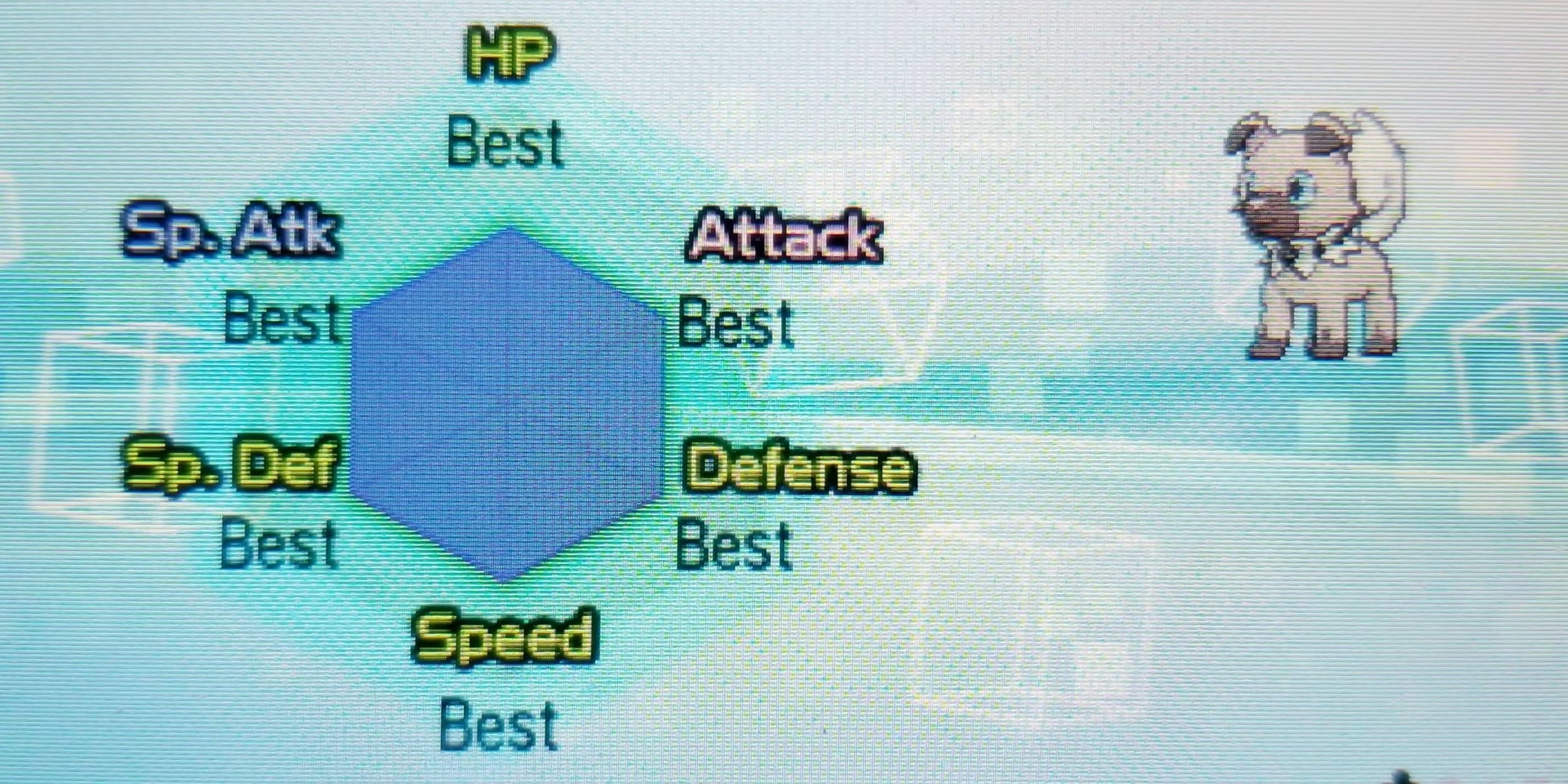
The summary screen from Sun and Moon showing a Rockruff after Hyper Training.
Individual values, abbreviated to IVs, is as a factor in determining a portion of a Pokémon's stats.
Bottle Cap and Gold Bottle Cap were introduced in Pokemon Sun and Moon, they are spent on Hyper Training which increase a Pokémon's IVs and have reappeared in nearly every mainline Pokémon.
Every stat (HP, Attack, Defense, Sp. Atk, Sp. Def, and Speed) has an IV ranging from 0 to 31. Individual values are provided randomly for every Pokémon, caught or bred. For example, a Pokémon could have the IVs 7/27/31/14/19/2, in HP/ATK/DEF/SPA/SPD/SPE format. At level 100, a Pokémon's IVs are added to its stats for their total values. For example, a level 100 Tyranitar with no effort values and 0 IVs has 310 HP; however, if it has 31 IVs, it would have 341 HP.
As insignificant as 31 points may seem, high IVs are required for Ace Trainers to obtain when breeding Pokémon with perfect natures/stats. On some occasions, they are even the tipping point in a close matchup. For example, if Terrakion had an 0 Attack IV, it will have an attack of 358 at level 100 (with an attack improving nature), while a Terrakion with perfect Attack IVs would have 392 Attack. This small difference can mean the difference between a one-hit kill (not a one-hit knockout move) and survival with 1 HP.
Manipulating IVs
Fortunately for some Pokémon can be bred to obtain the desired IVs.
The process of breeding IVs is as follows:
Three IVs are inherited from the parents, and are selected in three checks:
First check: A known IV (HP/ATK/DEF/SPA/SPD/SPE) is selected from either the Mother or the Father and passed on to the child.
Second check: A random IV with the exception of HP (ATK/DEF/SPA/SPD/SPE) is selected from either the Mother or the Father and passed on to the child.
Third check: A random IV with the exception of HP and DEF (ATK/SPA/SPD/SPE) is selected from either the Mother or the Father and passed on to the child.
Because of these checks, a parent is more likely to pass on its IV for ATK or SPA to its offspring; however, letting the parent hold a Power Item guarantees that the IV of Power Item's boosted stat will be passed on. In Gen 7 Hyper Training was introduced that allows you to directly increase a Pokémon IVs.
Checking IVs
Beginning in Generation III, there has sometimes been an NPC that allows players to check the IVs of their Pokémon. Their locations are listed below:
Pokémon HeartGold Version and Pokémon SoulSilver Version: The NPC is located in the Battle Tower, dressed like a scientist and standing closest to the PC on the top right side of the room. He will only give information about one of a Pokémon's IVs each time he is asked, so he should be consulted more than once to learn about all of a Pokémon's IVs.
Pokémon Black Version and Pokémon White Version: The NPC is located in the Battle Subway, closest to the exit. He will give information about a Pokémon's highest IVs. If it has more than one, he will include all of the information in a single consultation according to the list below.
Sum of IV's:
"This Pokémon's potential is decent all around." (0-90)
"This Pokémon's potential is above average overall." (91-120)
"This Pokémon has relatively superior potential overall." (121-150)
"This Pokémon has outstanding potential overall." (150-186)
One IV:
"It's rather decent in that regard." (0-15)
"It's very good in that regard." (16-25)
"It's fantastic in that regard." (26-30)
"It can't be better in that regard." (31)
Formula
The formulae for calculating a Pokémon's IVs are as follows:
The formula for the HP IV, which differs from the rest of the IVs:
In layman terms:
means to take the amount of EVs (σ) you have in HP, divide it by 4, and then round down.
The formula the rest of the IVs:
In layman terms:
means to take the amount of EVs you have in the particular stat, divide it by 4, and then round down.
means to take the Current Stat Value, divide it by the bonus from the Pokémon's nature (φ), and then round up. If the stat gets an increase from the nature, divide the Current Stat Value by the constant 1.1; if it gets a decrease from the nature, divide the Current Stat Value by the constant 0.9.
The formulae for calculating stats are different from calculating IVs.
Generation I and II
The formulae are known as "Oak's Theorem". It is denoted by the letter ρ (Rho).
Hit Points:
Other Stats:
Where:
B - Base Stat
I - Individual Values
σ - Effort Value
α - Pokémon's Level
Example:
Find the total HP stat of a Level 40 Lugia.
Substitute:
B - 106
I - 6
σ - 50000
α - 40
Since it is HP, the HP version will be used.
Substituting every givens into the formula:
Doing the order of operations:
Rounding it off to the nearest stat:
Generations III and above
The formulae are known as "Birch's Theorem". It is denoted by the letter Γ (Gamma).
Hit Points:
Other Stats:
B - Base Stat
I - Individual Values
σ - Effort Value
α - Pokémon's Level
φ - Nature
The important constants of Nature (φ) are as follows:
1.1x increase for the main Nature's first stat
0.9x decrease for the main Nature's second stat
Example:
Find the Defence stat of a Level 40 Accelgor with a Bold nature.

![{\displaystyle IV_{HP}=[(S-\alpha -10)\times ({\frac {100}{\alpha }})-2\times B-({\frac {\sigma }{4}})]}](https://services.fandom.com/mathoid-facade/v1/media/math/render/svg/ece840ce4b620ac1d8b97c9094f6c19776ab84af)
![{\displaystyle IV_{HP}=[(Stat_{currentlevel}-Base_{currentlevel}-10)\times ({\frac {100}{Base_{currentlevel}}})-2\times B-({\frac {EV}{4}})]}](https://services.fandom.com/mathoid-facade/v1/media/math/render/svg/09ecd693bfbbfaababca00a1bd4ccd2c8e78e283)

![{\displaystyle IV_{stat}=[({\frac {S}{\phi }}-5)\times ({\frac {100}{\alpha }})-2\times B-({\frac {\sigma }{4}})]}](https://services.fandom.com/mathoid-facade/v1/media/math/render/svg/0ee3d4fa037330eee1b7eef1575d9949df6d5e0a)
![{\displaystyle IV_{stat}=[({\frac {Stat_{currentlevel}}{Nature_{constant}}}-5)\times ({\frac {100}{Base_{currentlevel}}})-2\times B-({\frac {EV}{4}})]}](https://services.fandom.com/mathoid-facade/v1/media/math/render/svg/01e5937e4b338b060cd9ddf70b165b809b675de6)

![{\displaystyle \rho _{HP}=\left[{\frac {(B+I)\times 2+\left[{\frac {\sqrt {\sigma }}{4}}\right]\times \alpha }{100}}\right]+\alpha +10}](https://services.fandom.com/mathoid-facade/v1/media/math/render/svg/242b8ddc25e3e0f184774c24f1d2fba0a4551aef)
![{\displaystyle \rho _{other}=\left[{\frac {(B+I)\times 2+\left[{\frac {\sqrt {\sigma }}{4}}\right]\times \alpha }{100}}\right]+5}](https://services.fandom.com/mathoid-facade/v1/media/math/render/svg/2f95ff606dffe87cd8b57f380b538eb6a9f51291)
![{\displaystyle \rho _{HP}=\left[{\frac {(106+6)\times 2+\left[{\frac {\sqrt {50000}}{4}}\right]\times 40}{100}}\right]+40+10}](https://services.fandom.com/mathoid-facade/v1/media/math/render/svg/8729ecfb4823338cf003355cc9d6cfb823010a67)
![{\displaystyle \rho _{HP}=\left[{\frac {112\times 2+\left[{\frac {\sqrt {50000}}{4}}\right]\times 40}{100}}\right]+40+10}](https://services.fandom.com/mathoid-facade/v1/media/math/render/svg/ea8caf8a6295fc9f92452dbc8d3b66f2a57a7884)
![{\displaystyle \rho _{HP}=\left[{\frac {112\times 2+\left[{\frac {224}{4}}\right]\times 40}{100}}\right]+40+10}](https://services.fandom.com/mathoid-facade/v1/media/math/render/svg/9dfd88f70a046e153b01303ea730495b80dbacc1)
![{\displaystyle \rho _{HP}=\left[{\frac {224+56\times 40}{100}}\right]+40+10}](https://services.fandom.com/mathoid-facade/v1/media/math/render/svg/590fe48d8c95749649caf63f9f9a0069398b9f0d)
![{\displaystyle \rho _{HP}=\left[{\frac {224+2240}{100}}\right]+40+10}](https://services.fandom.com/mathoid-facade/v1/media/math/render/svg/74257725136d99f23bbeea2b8fc909a31a3f4bc9)
![{\displaystyle \rho _{HP}=\left[{\frac {2464}{100}}\right]+40+10}](https://services.fandom.com/mathoid-facade/v1/media/math/render/svg/e3cf0eed9b44561a992ff8f567399ddd70324c2c)


![{\displaystyle \Gamma _{HP}=\left[{\frac {\left(2\times B\times I+\left[{\frac {\sigma }{4}}\right]\right)\times \alpha }{100}}\right]+\alpha +10}](https://services.fandom.com/mathoid-facade/v1/media/math/render/svg/15b9558b83aebe8836b8957441cec2948ac73ce4)
![{\displaystyle \Gamma _{other}=\left(\left[{\frac {\left(2\times B\times I+\left[{\frac {\sigma }{4}}\right]\right)\times \alpha }{100}}\right]+5\right)\times \varphi }](https://services.fandom.com/mathoid-facade/v1/media/math/render/svg/4278e16856f199445e2390473e5c03b771b53e69)
![{\displaystyle \Gamma _{Def}=\left(\left[{\frac {\left(2\times 40\times 7+\left[{\frac {116}{4}}\right]\right)\times 51}{100}}\right]+5\right)\times 1.1}](https://services.fandom.com/mathoid-facade/v1/media/math/render/svg/2e8fe0c761cecdcb7c07a03fc634aeab93d1bc6a)
![{\displaystyle \Gamma _{Def}=\left(\left[{\frac {\left(560+\left[{\frac {116}{4}}\right]\right)\times 51}{100}}\right]+5\right)\times 1.1}](https://services.fandom.com/mathoid-facade/v1/media/math/render/svg/ea76e13531cd77e5511f070b49400d1318769e62)
![{\displaystyle \Gamma _{Def}=\left(\left[{\frac {\left(560+29\right)\times 51}{100}}\right]+5\right)\times 1.1}](https://services.fandom.com/mathoid-facade/v1/media/math/render/svg/4358e1185cbe3327f9b4a5cc619b022abc6f59bb)
![{\displaystyle \Gamma _{Def}=\left(\left[{\frac {589\times 51}{100}}\right]+5\right)\times 1.1}](https://services.fandom.com/mathoid-facade/v1/media/math/render/svg/2ef09e183b1a99c1f24ac6499406845f62025901)
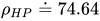
![{\displaystyle \Gamma _{Def}=\left(\left[{\frac {30039}{100}}\right]+5\right)\times 1.1}](https://services.fandom.com/mathoid-facade/v1/media/math/render/svg/18acb486e5e4f9e6ff7a802df3f2a2df2e662a5d)



![{\displaystyle \Gamma _{Att}=\left(\left[{\frac {\left(2\times 40\times 7+\left[{\frac {70}{4}}\right]\right)\times 51}{100}}\right]+5\right)\times 0.9}](https://services.fandom.com/mathoid-facade/v1/media/math/render/svg/0e1bee2791240462039af97916e1333bbdd79c9c)
![{\displaystyle \Gamma _{Att}=\left(\left[{\frac {\left(560+\left[{\frac {70}{4}}\right]\right)\times 51}{100}}\right]+5\right)\times 0.9}](https://services.fandom.com/mathoid-facade/v1/media/math/render/svg/216539eb7b8455aedb844f4783be00786381625b)
![{\displaystyle \Gamma _{Att}=\left(\left[{\frac {\left(560+17.5\right)\times 51}{100}}\right]+5\right)\times 0.9}](https://services.fandom.com/mathoid-facade/v1/media/math/render/svg/47705d6e7e6a117c747f6a37b2942e0c2f86f173)
![{\displaystyle \Gamma _{Att}=\left(\left[{\frac {577.5\times 51}{100}}\right]+5\right)\times 0.9}](https://services.fandom.com/mathoid-facade/v1/media/math/render/svg/aae0a1cb4a36b36ef6a19202ffe4d0295e35289c)
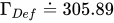
![{\displaystyle \Gamma _{Att}=\left(\left[{\frac {29452}{100}}\right]+5\right)\times 0.9}](https://services.fandom.com/mathoid-facade/v1/media/math/render/svg/99f8d84dda19edd91669696aaeeb0bd6b3507dd7)



