

Logo of fainting in Generation VIII
Faint (ひんし, Hinji?, lit. Near death), titled unable to battle (戦闘不能, sentou funou?) in the anime and abbreviated FNT, is the status condition when a Pokémon's HP depletes completely (drops to 0), usually as the result from a Pokémon battle or other conditions such as Poison or Burn. When this occurs, it normally falls into unconsciousness.
If all of the Pokémon in a Trainer's party have fainted during a battle, whether it is from another or against a wild Pokémon, it results in a loss for said Trainer.
In the games
In the core series, when the HP of the player's Pokémon reaches 0, it will cause it to leave the battlefield with a slowed or distorted cry (Generations I and II has it played in normal speed), as the Pokémon is consequently knocked out. The condition is displayed as "FNT" in a red status bar or otherwise. If more Pokemon in the party are available, the player must replace their defeated Pokémon with another, unless all are fainted, in which the player will Black Out (the franchise's equivalent of Game Over). Consequently, the player will lose money as a penalty and immediately warp back to the last visited Pokémon Center (or the player's house if this occurred early in the quest). The money is given to the winner in a Trainer battle, but in a wild battle it is dropped in panic.
If an opponent Trainer's Pokémon faints, similar rules apply, as they will replace their fallen partner for another until they run out of available Pokémon. In the wild, the Pokémon retreats from the area after it collapses. In either case, experience points are gained.
Despite this Status Condition saying it is fainted and therefore unable to battle, Pokémon can still use in-field HM moves that it knows, such as Fly or Surf, implying it is not completely knocked out unconscious, but rather simply injured. It is also able to evolve if the conditions are met. However, it cannot gain any experience until it is revived.
The money dropped or given when the player blacks out during a loss is calculated by the level of every member in the party. In games prior to Generation III, however, the player will lose half of their total amount with the game not explicitly stating what happened. Therefore, it is strongly recommended not to let all of the party's Pokemon faint.
Direct damage
- All moves will faint the target if they have dealt enough damage.
- One-hit knockout moves like Sheer Cold or Guillotine will instantly faint the target if landed. Destiny Bond will knock out the Pokémon who knocked out the user, while Perish Song will cause all Pokémon on the field, except for Pokémon with Soundproof, to faint on 4 turns.
- Moves that involve taking the user out like Self-Destruct or Explosion will immediately cause fainting.
- Assuming the user is at low HP, Curse used by a Ghost-type Pokémon and recoil from moves like Take Down or Wild Charge will effectively knock the user out.
Indirect damage
- Prior to Generation V, Poison will effectively cause fainting if given enough time, dealing 1 HP of damage every 4 steps the player takes. It is automatically cured if the Pokémon is at 1HP as of Generation IV, and the mechanic as a whole was removed in later Generations.
- Burned Pokémon also take damage from their burn. Unlike Poison, however, it won't cause damage outside of battle.
- Confusion may knock out the affected Pokémon considering it hurts itself a lot. In addition, this can also occur through disobedience.
- Leech Seed may cause fainting due to it siphoning away HP.
- Weather and Entry Hazards may cause fainting if they deal enough damage.
Glitches
- If a Pokémon with low HP is given a Pomeg Berry, a Glitch may cause fainting due to the reduced HP EVs.
Effects
The Friendship of the Pokémon is decreased, and if left with no more Pokémon to battle with, the player blacks out. Starting from Pokémon FireRed Version and Pokémon LeafGreen Version and Generation IV, a cutscene explains what happens, saying the player protects their Pokémon from further harm before reaching the Pokémon Center.
The Pokémon is considered fainted unless a Revive, Max Revive, or Revival Herb (at the cost of friendship) is used, or it is healed by a Pokémon Center. A Rare Candy may also revive a fainted Pokémon due to the HP it gains while leveling up.
In the anime


A fainted Vanillish in Pokémon the Series
In Pokémon the Series, a fainted Pokémon is referred to as unable to battle, and is marked by stunned expressions or swirled eyes akin to dizziness. However, being "unable to battle" does not necessarily mean the Pokémon is knocked out unconscious, but simply not having the energy, ability, or other reasons to continue battling. In some cases, unlike in the games, Pokémon can recover quickly after being fainted once checked by their Trainer, especially if they are not hurt too badly.
As certain Pokémon lack eyes, they have differing ways to indicate fainting, like the Staryu line's core flashing. In most other cases, the Pokémon's eyes may simply close as they collapse from exhaustion.
It may instantly end a battle competition during a contest. During Gym battles, League Conference matches, and other battle-oriented competitions, once a Pokémon is deemed unable to battle by a judge, it must be recalled and cannot be used once more. This rule is also commonly observed during informal battles Ash Ketchum had with his rivals, in which Brock or another person acts as the referee.
There have been other cases in the anime where being unable to battle does not follow the rules seen in the core games. For example, the Indigo Plateau Conference is unfairly strict with a rule as switching out, disobedience and even Pokémon being put to sleep or freeze is what makes them considered as fainted.
Trivia
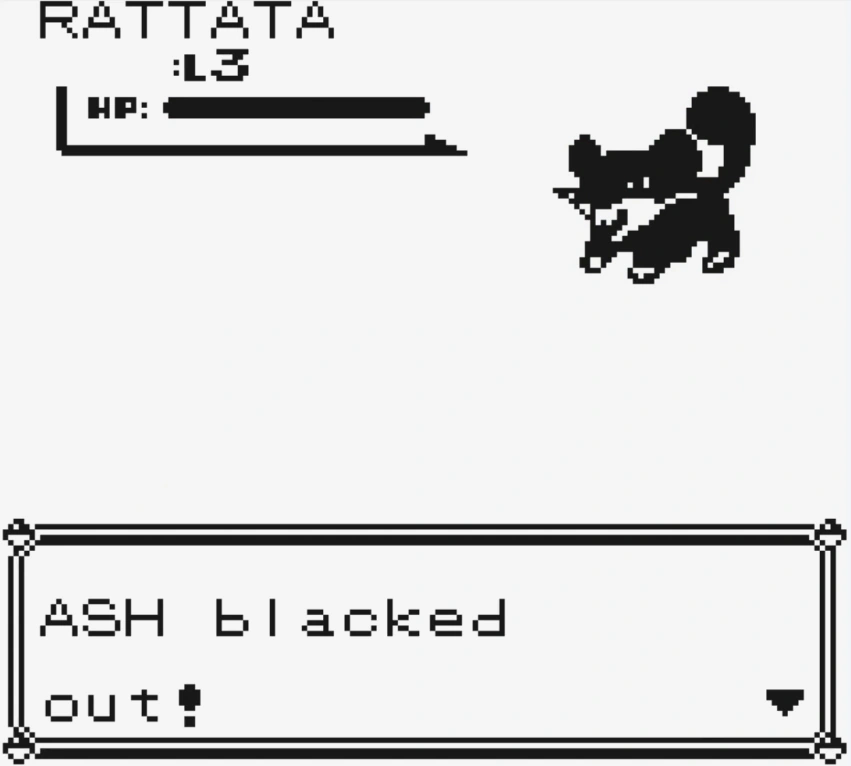

The player receiving a Black Out in Pokémon Yellow Version: Special Pikachu Edition
- Despite the Japanese meaning of this status condition being "near death" as of Generation IX, it is shown in both the games and anime that the Pokémon are merely knocked out and often still breathing. According to the franchise's creator Satoshi Tajiri in an interview, he explained that Pokémon were designed to faint instead of dying in the main series unlike other RPG games to avoid children developing an abnormal understanding of death, as he felt they do when playing most other video games (as it is extremely common otherwise, even in family-friendly titles), and to encourage children to treat death with respect.
- Some fans, however, especially newcomers, do erroneously mistake fainting as dying. In such cases, players have created a challenge known as "Nuzlocke" (more often seen in unofficial ROM hacks of older games) to significantly increase difficulty, primarily requiring them to immediately release or permanently box any Pokémon that faints and only catch the first wild Pokémon encountered in each new area.
- In the 2D games, Pokémon fainting results in them collapsing. In 3D games, they are usually recalled to their Poké Balls as they are defeated. In Pokémon the Series, they almost always collapse on the battlefield.
- In Generation I (when played in color) and Generation II games, whenever the player blacks out from all of their own Pokémon fainting, the opponent Pokémon and their HP meter turns black as the message appears.
- The Pokémon Stadium games are famously known to have unique fainting animations of Pokémon as they begin to collapse, such as Magneton breaking entirely into pieces or Electrode's eyes sticking out in a very cartoonish manner. This is carried over in some degree to later spin-offs such as Pokémon Colosseum and Pokémon XD: Gale of Darkness.
- Sometimes during the adventure in gameplay, if there's a Trainer battling alongside the player (such as Steven in Pokémon Emerald Version), they will heal the Pokémon after every battle or before a tough battle against a strong opponent.
- Perhaps humorously, official merchandise of fainted Pokémon exist and are available to purchase.
- Nurses and Doctors in Generation V heal the player's Pokémon every time they are talked to after defeating them in battle the first time talking to them. Most of the time Pokémon will grow to like the player character more if they don't just rely on Pokémon Centers for healing, but using Revives and Potions to keep them from fainting, as long as a Pokémon is still healthy.
- A Sacred Ash can be used to heal all fainted Pokémon at once.
- In Pokémon: Let's Go, Pikachu! and Pokémon: Let's Go, Eevee!, the Partner Pikachu/Eevee continues to ride on the player despite being fainted. However, if they attempt to interact with it, Partner Play is unavailable until it revives, as the Pokémon is too tired to play.
- In Pokémon Legends: Arceus, unlike other games, having all of the party's Pokémon fainted will not result in the player blacking out, as they are allowed to continue the game. However, since there are no longer any Pokémon to protect the player character from danger, they are now defenseless and are at risk of getting knocked out themselves from aggressive wild Pokémon, especially Alpha Pokémon.
- One Pokémon, Spinda, notably has constant spiral eyes, making it always appear to be fainting or confused.
- In the Pokémon games where Pokémon have a proper fainting animation, the Pokémon usually closes its eyes as it falls down, similarly to the anime.
- Falinks in Generation VIII is an exception, as they use the swirled eyes animation much like how most Pokémon faint in the anime. In Generation IX, however, this was changed to having their eyes closed upon fainting.
Gallery


